The method for checking the tightness of wire thread inserts can be summarized as “inspect, measure, and verify”:
I. Visual Inspection
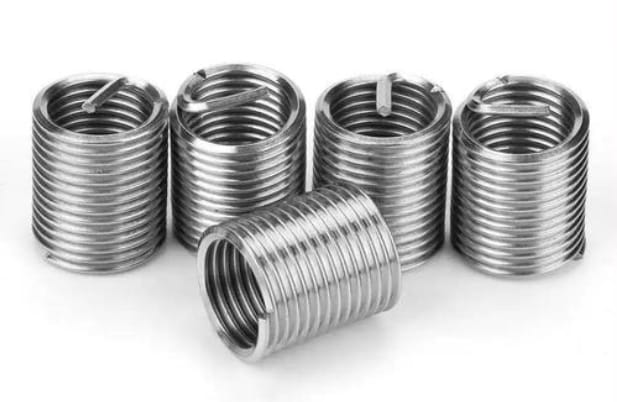
After installation, first observe whether the wire thread insert is flush with the surface of the base material. Under normal conditions, the complete thread coils should be evenly exposed without significant misalignment, and the overall depth should not exceed one-quarter of the insert’s length. If localized protrusions or depressions are detected, an adjustment tool must be used for correction.
II. Tool-based Inspection
1. Feeler Gauge Test: Use a feeler gauge with 0.05 mm precision and slide it into the gap between the insert and the base material’s threads. If the gap on one side exceeds 0.08 mm, looseness may be present, requiring the insert to be screwed in again.
2. Torque Wrench Verification: Select an appropriate thread gauge and apply standard torque (usually 60%–80% of the specification parameters). For example, an M6 wire thread insert is considered acceptable if it withstands a torque of 1.2–1.8 N·m without rotating.
III. Thread Fit Verification
Apply marking dye to the mating bolt and screw it in; observe the thread contact area to ensure it is at least 75%. An acceptable fit allows the bolt to be screwed in by hand for one-third of the length, after which a tool is required to tighten it gradually. Conditions that are too loose (bolt can be screwed in entirely by hand) or too tight (installation depth not reached after two turns with tool pressure) require rework.
Different operating conditions require specific approaches: for precision instruments, pneumatic gauges are recommended to check coaxiality; for high-temperature environments, inspection tools with matching thermal expansion coefficients should be used. In practice, avoid repeated removal and inspection of titanium alloy wire thread inserts to prevent damage to the surface oxide layer, which could affect precision. Mastering the correct installation technique can raise the pass rate to over 95% and effectively extend the service life of the threaded structure.